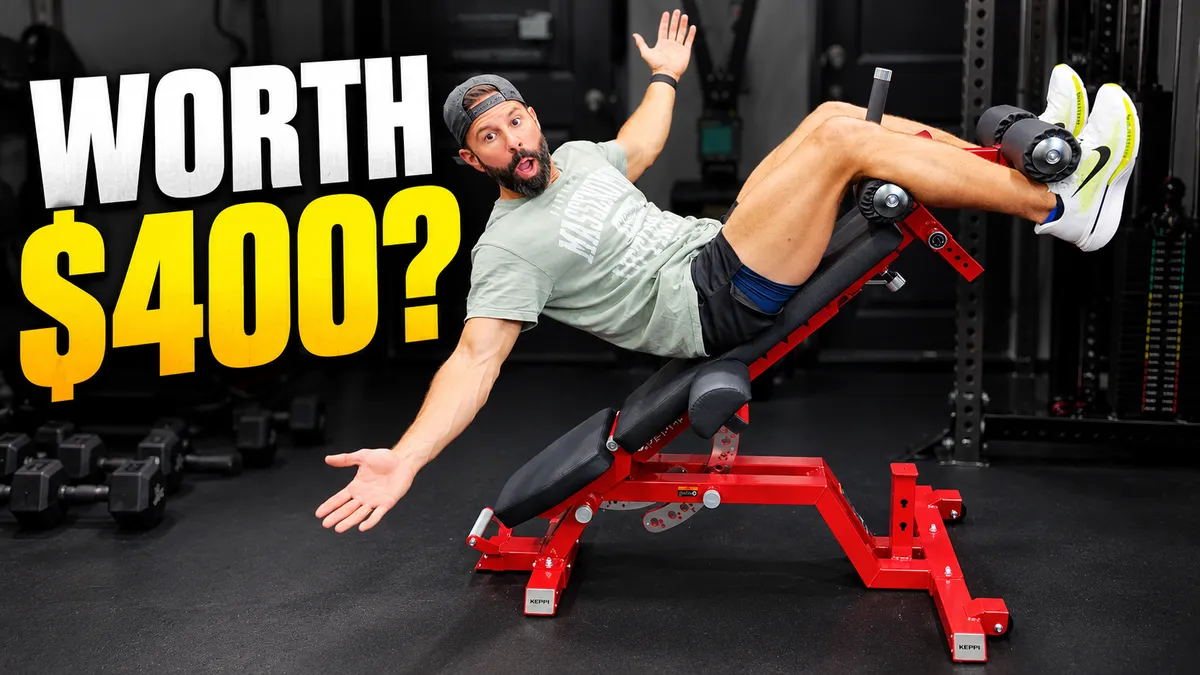
Keppi Bench 6000 Review: Loaded for $400, But There’s a Catch
The 2026 Keppi Bench 6000 is a flat, incline and decline (FID) bench that sells for about $400, and it packs a lot in for that price: 11 back pad positions, 8 seat positions, a detachable decline sit-up attachment, removable curl pads, and a row of built-in ports for attachments Keppi may release down the road.
More features don't automatically make a better bench, though. I've been training on the Bench 6000 in my studio, and there are things I really like about it and a couple of real downsides. Here's what it does well, what got annoying, how it compares to the REP AB-3000 2.0, and whether it's worth buying.
[[BTN:Check~Price~at~Keppi|https://liftlabreviews.com/keppi-bench]]
Quick Verdict
[[VERDICT:7|Stable~and~Loaded,~Held~Back~by~Sticky~Pins|Rock~solid~and~packed~with~adjustability~and~included~attachments~for~about~$400,~but~the~slick~pad~and~sticky~decline~attachment~pop~pins~keep~it~from~a~higher~score.]]
[[RATING:Stability=9.5;Build~Quality=8;Adjustability=9;Padding~and~Grip=6;Ease~of~Adjustment=5;Attachments=7;Mobility~and~Storage=9.5;Value=7.5]]
The Keppi Bench 6000 is a stable, feature-loaded bench at a fair price. It's rock solid flat, inclined and in deep decline, it rolls and stores upright easily, and the included decline attachment and curl pads add real value. The trade-offs are slick, slightly soft padding and pop pins on the decline attachment that stick and fight you when you adjust it.
If you want maximum adjustability and room for future attachments, it's a strong pick for the money. If a grippy, firm pad and fast, smooth adjustments matter most to you, look elsewhere.
Keppi Bench 6000 Specs
Specs are from Keppi's product page, checked October 21, 2026, unless noted. The pad gap is my own measurement.
[[SPECS:Price=$399.99~(Keppi,~Oct~21,~2026);Weight~Capacity=1,500~lb~(manufacturer~rating);Back~Pad~Positions=11~(0°~to~85°);Seat~Positions=8~(-37.5°~to~30°);Flat~Height=17.12~in;Back~Pad~Width=11.8~in;Pad~Thickness=2.75~in;Pad~Gap=About~1.7~in~(my~measurement);Bench~Weight=97~lb~(Keppi~Amazon~listing);Frame=Q235~steel;Included=Decline~sit-up~attachment~and~detachable~curl~pads;Storage=Upright,~with~wheels~and~front~handle;Warranty=Lifetime~(per~Keppi~product~page)]]
Pros and Cons
[[PROS:Very~stable~flat,~inclined~and~in~deep~decline;Wide~rear~base~and~a~wider~front~T~base~than~most~benches;11~back~and~8~seat~positions,~with~the~seat~down~to~-37.5°;Back~and~seat~pop~pins~lock~through~both~sides~of~the~frame;Decline~attachment~and~curl~pads~included~at~about~$400;Built-in~ports~ready~for~future~attachments;Easy~to~roll~and~stores~upright]]
[[CONS:Slick~vinyl:~a~plate~slid~at~37.5°~where~it~sticks~on~my~Apex~Bench;Padding~runs~a~little~soft;Decline~attachment~pop~pins~stick~and~won't~always~re-engage;Tight~tolerances~made~the~decline~attachment~hard~to~assemble;Screw~knob~scrapes~paint~inside~the~holes;Curl~pads~fall~off~their~storage~spot~when~you~move~the~bench]]
Build Quality, Assembly and First Impressions
The bench showed up in one box, very well packaged. Everything was bubble wrapped and neatly organized, and the only flaw I found was one minor scratch on the bottom of the frame.
Overall it's built really well. The steel feels heavy gauge (Keppi lists a Q235 steel frame), the pop pins and knurled knobs have a nice finish, and the subtle Keppi logo on the pad looks clean. If you walked into a gym and saw it, you wouldn't peg it as a budget bench. It looks like what it is: a solid bench in the $400 range.
Assembly went smoothly except for one part: the decline sit-up attachment. The ports have very tight tolerances, with plastic inserts to snug up the fit, and I had real trouble getting the tubing through some of them. Adjusting it was stiff at first too. It has loosened up over time, and a little lubricant in the ports helped.
Stability: The Best Thing About This Bench
This bench is very stable. Part of that is the wide rear foot base, and the front T base is also a little wider than what a lot of benches use.
I set the back pad at a 45° decline for sit-ups, and it felt completely planted. Getting in and out never felt unsafe, and at no point did I feel like it would tip. Flat, with a pair of heavy dumbbells, there was no rocking side to side while pressing. Stability shouldn't be a question with this one.
Padding, Grip and Pad Gap
The padding looks great, but it's my second biggest complaint. Compared to REP and Get RX'D benches, and the [[LINK:Apex~Bench|https://liftlabreviews.com/post/apex-fitness-apex-bench-review]] I reviewed recently, the Keppi vinyl is much slicker and less tacky. Keppi describes the cover as non-slip PVC, but my testing didn't back that up.
The Plate Slide Test
I set the back pad to about 37.5° and laid a plate on it. On the Apex Bench, the same test at that angle, the plate stays put. On the Keppi, it slid right down the pad. I kept dropping the angle, and it still slid until about 20°, where it finally stuck.
If you do heavy bench pressing and like your upper back pinned to the pad, that slickness may become an issue. The padding also runs slightly on the softer side, so if you strongly prefer a firm pad, this probably isn't your bench.
Pad Gap and Back Pad Length
The pad gap measured about 1.7 inches, which isn't a big deal. I did see some complaints online from taller lifters about fitting on the bench. I'm about 5'8" and a half, and if I stay only on the back pad, my head tops out right at the end of it. That's true of a lot of benches, but this one may be slightly shorter.
Sit on the seat pad, though, and there's plenty of room. Letting my lower back arch over the pad gap left lots of space above my head for pressing. I'd expect most lifters over six foot to be fine as long as they use the seat.
Adjustability and Pop Pins
Adjustability is where the Bench 6000 shines on paper: 11 back pad positions from 0° to 85°, and 8 seat positions from -37.5° to 30°.
I like how the back and seat pop pins work. There's no knob to tighten. You pull the pin, and when it goes back in, it slides all the way across and locks into the frame on the other side. A lot of pop pins only engage one side, so you're always a little worried about them slipping. These feel solid and secure, and the logo pins look sharp.
Personally I prefer a ladder-style back adjustment. If you do too, keep that in mind, but these pins work really well.
One Decline Caveat
With the decline attachment on and the seat all the way down at -37.5°, the back pad bottoms out when you lower it. The lowest I could lock it was about 30°, so that's your minimum sit-up height in full decline. Small detail, but worth knowing.
Decline Sit-Up Attachment
The decline sit-up attachment comes included, along with the curl pads, so at about $400 you're all in. In theory it's great because it has so many adjustments. In practice, this is where most of my frustration with the bench came from.
The lower adjustment is a regular screw knob that sets the height. If you have tight quads you may want it higher. I left it in the middle, and that works for most people. The problem is that the knob scrapes paint off the edges of the holes as you screw it in, since there's nothing protecting the finish.
The other adjustments use pop-pin knobs that also tighten and loosen, and these are the real issue. The pins tend to pull out and get stuck, and then I can't get them to pop back in and engage, even when I'm lined up with a hole. Two of the knobs gave me trouble. Sometimes I have to take one off and whack it back in. One adjustment is so tight you almost need two hands, and the slide that moves the attachment in and out gets stuck the same way.
Those tight tolerances cut both ways. You don't want the attachment flopping around, and it doesn't. But it makes adjusting it a chore. Once the pins are actually in, it works really well: there's a handle to grab as you set yourself up, and at a 45° decline it feels very stable.
[[TRAINER:The~last~thing~I~want~between~sets,~or~between~clients~in~my~studio,~is~a~fight~with~a~pop~pin.~Adjustments~need~to~be~quick~and~predictable.~If~Keppi~made~the~decline~attachment~pins~work~smoothly,~this~bench~would~jump~to~another~level~for~me.]]
Curl Pads and Attachment Ports
The most unique part of this bench is the row of ports running up the side of the frame, plus the included curl pads. The pads slip onto two bolts with a small overhang, then you push in and slide down to lock them. It's a tight fit, but once they're on, they're rock solid.
With the pads in place, you can rest the lower part of your upper arm on them for supported incline curls. I've never had a bench with that feature. It's cool, I'd probably use it, but it's not a game changer. Having several port heights is a nice touch, since taller lifters can set the pads higher and shorter lifters lower.
There's also a storage spot for the pads on the bottom of the bench. They go on easily, but they sit loose, and they tend to fall off when you move the bench around.
The Real Upside: Future Attachments
What interests me most is what Keppi could build for these ports. Right now there are no other attachments for them. But there's a big opportunity for things like dumbbell holders or a preacher curl pad, and the top port used for the decline attachment could take something like a leg extension and leg curl attachment.
Bench attachment ecosystems are a big deal lately. Benches like the Apex Bench, the IronMaster bench and the Freak Athlete ABX are turning a bench into a more complete gym. Keppi has a chance to join that race at a lower price point, but today you're buying the potential, not the attachments.
Moving and Storage
This is a big upside. Keppi's listing puts the bench at 97 lb, but with the front handle and large rear wheels it feels a lot lighter than that to move. It also stores upright, which I consider almost a necessity on an adjustable bench now, and there's a notch at the top that protects the pad when it's flipped up in a corner.
The only nuisance is the curl pads again. Set the bench down and they sometimes drop right off the storage spot.
Keppi Bench 6000 vs REP AB-3000 2.0
If you're shopping adjustable benches in this range, the closest competitor is the REP Fitness AB-3000 2.0. REP lists it at $349.99 (checked October 21, 2026), so it's currently about $50 less than the Keppi. Here's where each one wins.
Where the Keppi Wins
Adjustability and attachments. Per REP's specs, the AB-3000 2.0 back pad declines to -12° and its seat has 5 positions from 0° to 20°. The Keppi seat goes all the way to -37.5° across 8 positions. Both include a leg roller for decline work, but only the Keppi adds curl pads and attachment ports for future upgrades, and REP says the AB-3000 2.0 can't be stored vertically. On the spec sheet, the Keppi also carries a higher rated capacity: 1,500 lb versus REP's 1,000 lb.
Where the REP Wins
Pad feel and overall quality. I much prefer REP's padding, which is tackier, and the overall build of the REP feels a hair better to me. The AB-3000 2.0 also uses a ladder-style back adjustment, which I prefer, and it currently costs less. One spec point goes to the Keppi here: REP lists a 2.1-inch pad gap, versus about 1.7 inches on my Keppi.
Which One Should You Get?
It comes down to what matters more to you. The REP is the tackier, slightly better-built bench. The Keppi has slicker, softer vinyl but more decline range, curl pads in the box, upright storage, and room to grow if Keppi releases more attachments.
Who Should Buy the Keppi Bench 6000 (and Who Should Skip It)
[[WHO:You~want~deep~decline~work~and~decline~sit-ups;You~want~a~decline~attachment~and~curl~pads~included~at~about~$400;You~like~the~idea~of~adding~attachments~later;You~need~a~bench~that~rolls~easily~and~stores~upright;You~value~a~rock-solid~base~for~heavy~dumbbell~pressing]]
[[SKIP:You~want~a~grippy,~firm~pad~for~heavy~barbell~bench~pressing;You~change~decline~settings~often~and~hate~fiddly~pins;You~strongly~prefer~a~ladder-style~back~adjustment;You~don't~need~decline~or~attachments~and~just~want~a~simple~adjustable~bench]]
Final Verdict: Is the Keppi Bench 6000 Worth It?
Overall, Keppi did a good job with this bench. It feels very stable, it has a ton of adjustability, and it looks great, from the branding to the knurled knobs. At about $400 with a decline attachment and curl pads included, it sits in a mid-tier price range, and a lot of more premium benches cost around $100 more with no attachments at all.
I do wish the padding were tackier and a little firmer. For me, though, the biggest issue is the pop pins on the decline attachment. If Keppi smooths those out, this bench jumps to another level. As it stands, that stickiness is a real downside, but you could still buy the Keppi Bench 6000 and be entirely happy with it.
[[BTN:Check~Price~at~Keppi|https://liftlabreviews.com/keppi-bench]]
[[BTN2:See~All~My~Discount~Codes|https://liftlabreviews.com/affiliates]]
FAQ
Is the Keppi Bench 6000 worth it?
For most home gyms, yes. You get a very stable FID bench with a decline attachment and curl pads included for about $400. The trade-offs are slick, slightly soft padding and sticky pop pins on the decline attachment.
Is the Keppi Bench 6000 stable?
Very. In my testing it didn't rock while pressing heavy dumbbells flat, and it felt planted at a 45° decline for sit-ups. The wide rear base and wider front T base are a big reason why.
How far does the Keppi Bench 6000 decline?
The seat goes down to -37.5°. With the decline attachment on and the seat fully down, the lowest I could lock the back pad was about 30°, which sets your minimum sit-up height.
What attachments come with the Keppi Bench 6000?
It includes a decline sit-up attachment and detachable curl pads. The frame has extra ports for future attachments, but when I tested it, Keppi hadn't released any others.
Is the Keppi Bench 6000 padding grippy?
Not very. In my plate test, a plate slid off the pad at about 37.5° and only stuck at about 20°, while it holds at 37.5° on my Apex Bench. The pad also feels slightly soft.
Can tall lifters use the Keppi Bench 6000?
Yes, as long as you sit on the seat pad. At 5'8" and a half, my head tops out at the end of the back pad if I stay only on it, but sitting on the seat leaves plenty of room. The pad gap measured about 1.7 inches.
Does the Keppi Bench 6000 store upright?
Yes. It rolls easily on large rear wheels with a front handle, and a notch at the top protects the pad when it's standing up. Keppi's Amazon listing puts it at 97 lb.
What is the Keppi Bench 6000 weight capacity?
Keppi rates it for 1,500 lb. That's the manufacturer's rating, not something I tested.
Should I buy the Keppi Bench 6000 or the REP AB-3000 2.0?
Get the Keppi if you want deeper decline, curl pads, upright storage and room for future attachments. Get the REP if you'd rather have a tackier pad, a ladder-style back adjustment and slightly better overall build for about $50 less.
More Reviews
[[ALT:Apex~Adjustable~Bench|17~back~pad~positions,~a~grippy~pad~and~a~growing~attachment~system.|https://liftlabreviews.com/post/apex-fitness-apex-bench-review]]
[[ALT:FED~Fitness~SR2~Squat~Rack|3x3~uprights~and~1-inch~holes~in~a~budget~rack~to~pair~with~your~bench.|https://liftlabreviews.com/post/fed-fitness-sr2-squat-rack-review]]
[[ALT:Synergy~Alpha~Dumbbell~Rack|A~4-tier~rack~with~flat~shelves~for~the~dumbbells~you'll~press~on~this~bench.|https://liftlabreviews.com/post/synergy-custom-fitness-alpha-dumbbell-rack-review]]