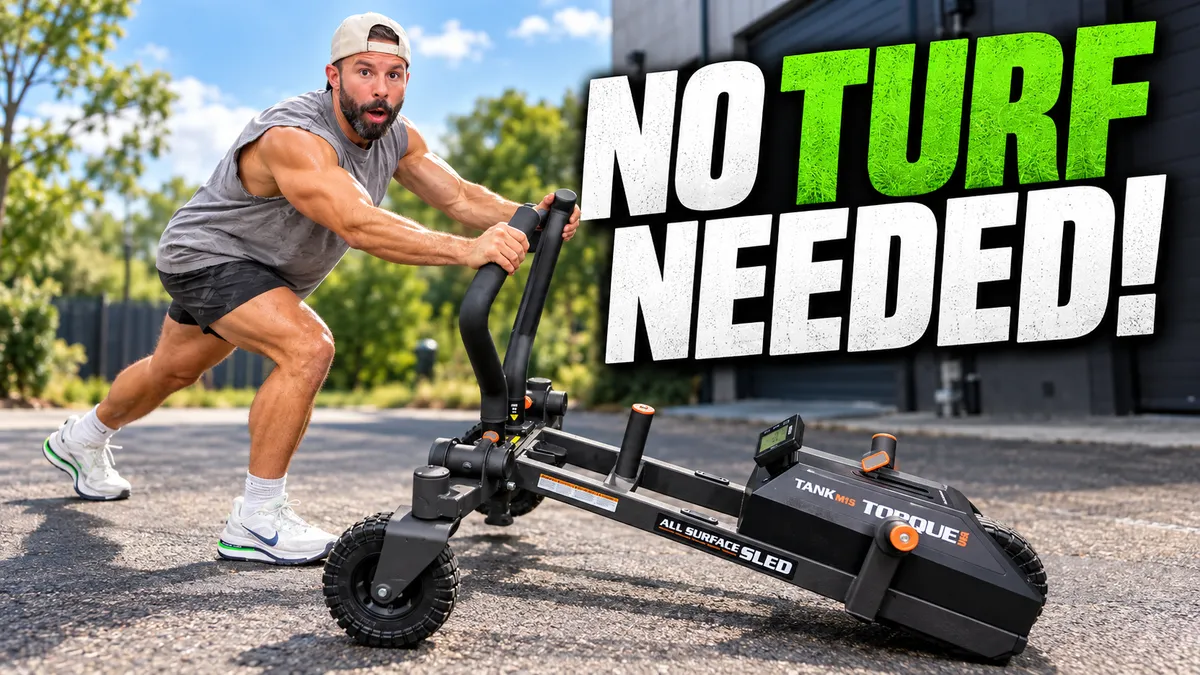
Torque TANK M1S Review: The Ultimate Home Gym Sled?
The Torque TANK M1S is one of the more interesting sled options for a home gym because it solves a problem most traditional sleds don't.
Actually having somewhere to use them.
A standard sled works great if you have a long turf lane.
But most home gym owners don't.
Take that same sled outside and now you're dragging steel across concrete or asphalt, making a ton of noise and slowly beating up the bottom of the sled.
The Torque TANK M1S takes a completely different approach.
Instead of dragging across the ground, it rides on large airless tires and uses Torque's magnetic resistance system to make the sled harder to push.
You can use it on pavement, concrete, turf, grass, dirt, and a variety of other surfaces.
It's almost silent.
And unlike the standard TANK M1, the M1S adds a 360-degree swivel wheel that makes changing direction incredibly easy.
The downside?
The sled alone costs around $1,300, and the Complete Kit pushes the price to around $1,500.
[[BTN:Shop~Torque~Fitness~→|https://www.torquefitness.com/#a_aid=LIFTLAB]]
[[NOTE:Using~my~affiliate~link~helps~support~LiftLab~Reviews~at~no~additional~cost~to~you.]]
I've spent the last couple of months using the TANK M1S in my own workouts and, more importantly, putting a bunch of my personal training clients on it.
I've used it for hard sled pushes, longer conditioning sessions, backward drags, resisted sprints, pulling variations, and wheelbarrow carries.
After all of that, I think the M1S is an excellent sled.
But I also don't think everybody needs to spend this much money on one.
Quick Verdict: Is the Torque TANK M1S Worth It?
[[VERDICT:9.0|Excellent~Premium~Home~Gym~Sled|The~M1S~combines~extremely~smooth~magnetic~resistance,~quiet~all-surface~wheels,~and~a~genuinely~useful~360-degree~swivel.~It's~expensive~and~isn't~ideal~for~extremely~heavy~pulls,~but~for~home~gyms,~neighborhoods,~and~personal~training~studios~where~noise,~surfaces,~and~maneuverability~matter,~it's~one~of~the~easiest~sleds~I've~used.]]
The biggest reason I like the M1S isn't that it somehow makes sled training more effective than a cheaper traditional sled.
It doesn't.
A basic sled loaded with plates can absolutely destroy your legs.
What you're paying for here is convenience.
No scraping steel across your driveway.
No loading a pile of plates just to make a push difficult.
No turf lane required.
And with the M1S specifically, no wrestling the sled around every time you reach the end of your run.
For my personal training studio, those things matter.
My Rating
[[RATING:Push~Performance=9.5;Maneuverability=9.5;Build~Quality=9.5;Versatility=8.5;Value=8.5]]
Torque TANK M1S Specs
[[SPECS:Price=Around~$1,300;Resistance=Neutral~Plus~3~Magnetic~Resistance~Levels;Front~Wheel=360°~Swivel;Tires=Large~Airless~Tires;Added~Weight=Top~and~Front~Plate~Horns;Console=Up~to~4~Users;Assembly=About~20~Minutes;Wheelbarrow~Mode=Yes;Wall~Mount=No]]
Torque TANK M1S Pros and Cons
[[PROS:Extremely~smooth~magnetic~resistance;Three~genuinely~useful~resistance~levels;Resistance~increases~as~you~push~harder;360°~swivel~makes~turning~extremely~easy;Nearly~silent~compared~with~a~traditional~sled;Works~on~concrete,~pavement,~turf,~grass,~and~other~surfaces;Doesn't~require~plates~for~difficult~sled~pushes;Excellent~build~quality;Comfortable~multi-position~handles;Great~for~personal~training~and~multiple~fitness~levels;Useful~for~backward~walking~and~dragging;Console~provides~useful~workout~data;Airless~tires~require~very~little~maintenance]]
[[CONS:Expensive~compared~with~a~traditional~sled;Swivel~wheel~can~cause~some~users~to~veer~side~to~side;Pulling~resistance~isn't~as~challenging~as~pushing;Wheelbarrow~mode~isn't~particularly~difficult~for~stronger~lifters;Takes~up~floor~space;No~wall-mount~storage~like~the~M1;Complete~Kit~pushes~the~price~even~higher]]
The Magnetic Resistance Is the Best Part of the TANK
The M1S has four positions on the resistance lever:
Neutral.
Level 1.
Level 2.
Level 3.
And after using all of them quite a bit, I actually think they all serve a purpose.
Neutral is mostly for moving the sled around.
But Levels 1 through 3 create three very different training experiences.
Level 1: Low-Intensity Conditioning
Level 1 isn't particularly difficult.
There's resistance there, but I can push the sled around my neighborhood for 20 to 30 minutes, take a few short breaks, and get a solid aerobic workout.
That's something I wouldn't normally associate with sled training.
Most people think of sleds as short, brutal pushes.
Load it up.
Drive as hard as you can.
Collapse.
Repeat.
With Level 1, the TANK can become more of a low-impact conditioning tool.
You're still working the quads, calves, shoulders, and cardiovascular system, but the intensity is much more manageable.
Level 2: The Sweet Spot for Most of My Clients
Level 2 is where I spend most of my time when I'm training clients.
It's hard.
But it's manageable.
I'll typically have someone push the sled 100 to 200 feet, take a short break, and then push it back.
For most average trainees, that's plenty of resistance to create a very challenging conditioning interval.
And because I can change the resistance with one lever, I don't have to keep adding and removing plates every time a different client walks into the gym.
That's one of those small conveniences that becomes much more valuable when you're training people all day.
I've found a similar advantage with adjustable resistance on the REP STRIVE VPR Air Bike.
Being able to change the machine instead of forcing every athlete to adapt to one fixed resistance level makes equipment much more useful in a personal training environment.
Level 3 Is Brutal
Level 3 is where things get nasty.
I don't need to add any plates for normal sled pushes.
If I'm driving into the M1S as hard as I can, a 100- to 200-foot push is plenty.
And there's another important part of the magnetic resistance system.
The resistance isn't simply fixed at Level 3.
The harder and faster you push, the more resistance the sled creates.
That means Level 3 won't necessarily feel the same for everyone.
A stronger, more powerful athlete trying to accelerate the sled aggressively creates more resistance than someone moving it slowly.
That's one reason the three levels scale so well across different users.
You get the resistance setting.
Then you get the athlete's effort on top of it.
The Resistance Feels Extremely Smooth
This is one of the first things I noticed when I started training with the TANK.
There's no grinding.
No sticking.
No weird point where the resistance suddenly kicks in.
It feels incredibly smooth from the beginning of the push through the end.
And that smooth resistance makes it useful for more than just conditioning.
Hard sled pushes can give you a lot of leg work without much eccentric loading.
That means I can hammer my quads, glutes, and calves without producing the same type of muscle soreness I'd expect from adding another pile of squats or lunges to my workout.
That's one of my favorite uses for sled training in general.
The 360-Degree Swivel Is Why I'd Choose the M1S
The biggest difference between the TANK M1 and M1S is the swivel wheel.
And personally, I think it's worth having.
When I reach the end of the road, I can turn the M1S around almost instantly and push back in the opposite direction.
I can navigate turns.
I can move around tighter areas.
And when I'm training clients, I can keep intervals moving instead of stopping so someone can drag the entire sled around in a giant circle.
It sounds like a small convenience.
But when you're repeatedly doing down-and-back intervals, it adds up quickly.
There Is Some Side-to-Side Movement
The swivel isn't perfect.
Because that wheel is free to turn, any unevenness in your push can make the sled start drifting or swaying from side to side.
Personally?
I don't find it to be much of an issue.
I can keep the sled going relatively straight even when I'm pushing hard.
But some of my clients have struggled with it more.
I'll have people pushing it down the road and occasionally they'll start drifting toward the edge and have to make a small correction.
The crown and unevenness of an actual road can make that more noticeable.
So there is a bit of a learning curve.
If you know you only want to push perfectly straight lines and the idea of the sled moving side to side is going to drive you crazy, that's a legitimate reason to consider the standard M1 instead.
For me, the maneuverability is worth the tradeoff.
It's Almost Silent
This might be one of the most underrated reasons to buy a wheeled sled.
Traditional sleds on concrete are obnoxious.
If you've ever dragged one across a parking lot or driveway, you know exactly what I'm talking about.
The M1S is almost silent.
You'll hear a slight mechanical winding sound when you're pushing hard, but you're not getting metal scraping across pavement.
That's especially valuable for me because I live and train clients in a neighborhood.
Dragging a traditional sled up and down the street early in the morning would be a pretty effective way to make my neighbors hate me.
With the TANK, that's not really a concern.
You Can Use It on Almost Any Surface
The big airless tires are another major selling point.
I've used the M1S outside on the road and it works extremely well.
You can also use it on surfaces like:
Concrete
Asphalt
Turf
Grass
Dirt
Rubber flooring
The tires are completely airless, so you aren't worrying about punctures or constantly maintaining tire pressure.
After putting a decent amount of mileage on mine, the tires still look basically new.
If you already have a large dedicated turf strip inside your gym, this advantage matters considerably less.
A traditional sled may make more sense.
But for the average garage gym owner who doesn't have 50 feet of indoor turf, being able to roll the sled directly outside is a huge advantage.
The Handle Positions Are Comfortable
You have a few different pushing positions on the M1S.
There's a more traditional neutral position where I can lock my arms out and drive.
There are also angled grips that let me get lower, lean into the sled, and drive more through my shoulders.
The handles are comfortable and give you multiple positions.
There is some slight play when they're being used in certain positions because they don't lock into every mounting point the same way.
Once I'm actually pushing, though, I don't really notice it.
The main chassis itself is extremely solid.
Pulling Is Where the M1S Starts to Show a Weakness
Forward sled pushes are easily the M1S's strongest use.
Pulling is a little different.
The magnetic resistance doesn't feel nearly as challenging when I'm pulling the sled.
That's where the built-in weight horns become more important.
You have a plate holder on top along with additional plate holders on the front, so you can add load for pulling variations.
That helps.
But even loaded, I don't think the TANK becomes an ideal replacement for someone whose primary goal is extremely heavy sled drags.
A traditional sled loaded with a giant stack of plates can become brutally heavy.
The M1S doesn't quite give me that same feeling.
That's an important distinction.
Backward Walking Is Still Excellent
Even though the pulling resistance is lighter than I'd ideally want for maximal-strength work, I still really like using the TANK for backward walking.
Backward sled drags are one of my favorite ways to warm up the quads and knees.
And with the Complete Kit, you have multiple ways to do them.
You can use the straps.
You can use the harness.
You can use the tow rope.
You can also do forward resisted sprints.
The accessories make it easy to change how you're applying resistance without needing an entirely different piece of equipment.
The Complete Kit Adds a Lot of Versatility
The Complete Kit gives you several additional ways to use the sled beyond standard pushes.
My setup includes pulling straps, a padded harness, a long tow rope, and the console.
[[BTN:Check~Current~Torque~TANK~Pricing~→|https://www.torquefitness.com/#a_aid=LIFTLAB]]
The harness is padded and comfortable.
The straps work well for backward drags, rows, and pulling variations.
And the long tow rope opens up some additional pulling and conditioning options.
If you're interested in HYROX-style conditioning, mixed circuits, or using the sled for more than straight pushes, the accessories make considerably more sense.
Wheelbarrow Mode Is Fine, But I Wouldn't Buy It for That
You can remove the handles, reposition them, and turn the M1S into a wheelbarrow.
It's a cool feature.
It works.
And it gives you another movement option from the same piece of equipment.
But it's not something I've found particularly challenging.
Even after adding plates, the wheelbarrow carry doesn't get incredibly difficult if you already have decent deadlift or loaded-carry strength.
You could even perform a deadlift-type movement from that position.
The versatility is nice.
I just wouldn't look at wheelbarrow mode as one of the main reasons to spend the money on the M1S.
The Console Is Actually Worth Having
I have the console as part of the Complete Kit.
And while you absolutely don't need a screen to push a sled, I like having it.
You can set up four different users and track several useful metrics, including:
Workout time
Distance
Speed
Watts
Calories
Push energy
Push force
For personal training, distance alone makes the console useful.
Instead of saying, "Push down there and come back," I can actually give someone a measurable target.
It also makes it easier to track workouts over time.
Can you train perfectly well without it?
Absolutely.
But if I bought the sled by itself, the console is one of the accessories I'd seriously consider adding.
Build Quality Is Excellent
Torque called this thing the TANK.
That's pretty accurate.
The M1S feels extremely solid.
The frame feels overbuilt.
There's nothing about the main sled that feels cheap or flimsy.
After using it myself and having multiple clients train on it, I haven't found any major build-quality concerns.
It's the kind of piece I expect to last for years.
Assembly was also easy.
Mine was mostly put together already.
Installing the remaining components and console took me around 20 minutes.
That's about as painless as assembly gets for a piece of equipment this substantial.
Storage Is One of the Biggest Downsides
The M1S isn't tiny.
If you're storing it in a garage or home gym, it's going to take up some floor space.
And unlike the regular TANK M1, the M1S doesn't have the same wall-storage option.
That's definitely something I'd think about in a smaller home gym.
I did discover one workaround.
You can tilt the sled upright onto the front wheels and handles.
Torque doesn't really advertise that as a storage position, but it significantly reduces how far the sled sticks out into the room.
You could also remove the handles if you really needed to make it smaller.
Still, this isn't something you're folding flat and hanging on a wall.
You need somewhere to keep it.
TANK M1 vs M1S: Which One Would I Buy?
This is probably the biggest buying decision for most people.
The standard M1 gives you the same basic magnetic resistance concept without the swivel wheel.
It also costs less.
So do you actually need the M1S?
I think that depends entirely on how you're going to use it.
Buy the M1 If:
You mostly push in a straight line
You don't mind manually turning the sled around
You want to spend less
Wall storage matters to you
You prefer a fixed wheel for maximum straight-line stability
If you're training by yourself and you've got one long driveway, sidewalk, or turf lane, manually turning the sled around may not bother you at all.
In that situation, I'd seriously consider saving the money.
Buy the M1S If:
You train multiple clients
You frequently do down-and-back intervals
You need to navigate turns
You train in tighter areas
You value maneuverability
You want wheelbarrow functionality
You don't mind giving up wall-mounted storage
For my gym, I'd buy the M1S again.
The swivel saves time.
It's easier when I'm working with clients.
And the ability to immediately turn around and continue the workout is worth more to me than having the sled locked into a perfectly straight line.
Do You Even Need a Torque TANK?
This is the more important question.
Because a normal sled costs a fraction of the price.
If you have a large indoor turf lane, I don't think you need the TANK.
Buy a traditional sled.
Throw plates on it.
Go train.
Same thing if you have an outdoor area where you can drag a standard sled across concrete and you don't care about the noise.
The TANK doesn't suddenly make sled pushes magical.
What it does is remove most of the logistical problems that prevent home gym owners from actually using a sled.
That's the value.
Who Should Buy the Torque TANK M1S?
I think the M1S makes the most sense for:
Home gym owners without a dedicated turf lane
People who need a quiet sled for a neighborhood
Personal trainers working with multiple fitness levels
Anyone who wants magnetic resistance without constantly loading plates
People who train outdoors on multiple surfaces
Users who value easy turning and maneuverability
Anyone who wants both short hard pushes and longer conditioning sessions
The M1S makes the most sense when the convenience features actually solve a problem for you.
If they do, it's a fantastic piece.
Who Should Skip It?
I'd probably save the money if:
You already have a dedicated turf lane
You're happy using a traditional sled
You're primarily interested in extremely heavy sled pulls
Noise isn't a concern
You only need straight-line pushes
You don't have enough floor space to store it
There is no reason to spend $1,300 just because the M1S exists.
If a cheaper traditional sled works perfectly in your training environment, use the cheaper sled.
Final Verdict: Is the Torque TANK M1S Worth It?
After using the Torque TANK M1S for the last couple of months, I understand why people spend the money on these sleds.
The magnetic resistance isn't a gimmick.
It's extremely smooth.
All three levels serve a legitimate purpose.
Level 1 works for longer, lower-intensity conditioning.
Level 2 is excellent for most of my personal training clients.
And Level 3 can absolutely destroy me without adding a single plate.
The airless wheels let me take the sled outside and use it in places where a traditional sled would be incredibly loud and inconvenient.
And the swivel is something I genuinely appreciate every time I need to turn around.
There are weaknesses.
Pulling isn't nearly as challenging as pushing.
Wheelbarrow mode isn't something I use much.
It takes up a decent amount of space.
And some of my clients have a harder time keeping the swivel wheel moving perfectly straight.
But none of those things change what I think the M1S does best.
It makes sled training incredibly easy to actually use.
For my personal training studio, that matters.
If I were choosing between the M1 and M1S again, I'd still spend the extra money on the M1S.
[[VERDICT:9.0|Highly~Recommended~for~the~Right~Home~Gym|You~don't~need~a~$1,300~sled~to~get~a~great~workout.~But~if~you~need~something~quiet,~multi-surface,~easy~to~scale,~and~extremely~maneuverable,~the~M1S~solves~the~biggest~problems~that~make~traditional~sleds~inconvenient~for~home~gym~owners.]]
[[BTN:Shop~Torque~Fitness~→|https://www.torquefitness.com/#a_aid=LIFTLAB]]
[[BTN2:See~All~My~Partner~Discounts~→|https://liftlabreviews.com/affiliates]]
[[NOTE:Using~my~affiliate~link~helps~support~LiftLab~Reviews~at~no~additional~cost~to~you.]]
Torque TANK M1S FAQ
How much does the Torque TANK M1S cost?
The sled itself costs around $1,300, with additional packages and accessories available.
Pricing can change, so I'd check Torque's site for the current price.
How many resistance levels does the TANK M1S have?
The M1S has Neutral plus three levels of magnetic resistance.
Does the TANK M1S need weight plates?
Not for most sled pushes.
I find Level 3 more than difficult enough without adding plates.
Plates become more useful for making pulling variations harder.
Is Level 3 on the TANK M1S hard?
Yes.
Level 3 becomes extremely difficult when you're pushing aggressively because the resistance increases as you push harder.
I can get a very challenging workout from 100- to 200-foot pushes without adding plates.
Can you use the Torque TANK M1S on concrete?
Yes.
That's one of the biggest advantages.
The M1S uses wheels rather than traditional sled skis, making it dramatically quieter and easier to use on concrete and pavement.
Can you use the TANK M1S on grass?
Yes.
The M1S can be used on grass and other outdoor surfaces.
How difficult it feels can vary depending on the surface.
Does the TANK M1S move side to side?
It can.
Because of the swivel wheel, uneven pushing force can make the sled veer slightly.
It doesn't bother me very much, but some of my personal training clients have had to make small corrections when pushing it on the road.
Is the M1S better than the TANK M1?
It depends on what you value.
The M1 is less expensive and better suited to someone who primarily pushes in a straight line.
The M1S adds 360-degree maneuverability and wheelbarrow functionality.
I personally prefer the M1S because I frequently train clients and do down-and-back intervals.
Can the TANK M1S be wall mounted?
The M1S does not have the same wall-storage option as the standard M1.
Is the TANK M1S good for personal trainers?
I think it's excellent for personal training.
The magnetic resistance changes quickly, the three levels work for a wide range of fitness abilities, and the swivel makes it easy to keep intervals moving.
Is the Torque TANK M1S worth it?
If you already have a turf lane or can use a traditional sled without worrying about noise or surfaces, I'd save the money.
If you need a quiet, multi-surface sled that's easy to maneuver and requires very little setup between users, the M1S is much easier to justify.
More Conditioning Equipment Reviews
If you're building out the conditioning side of your home gym, I'd read this next:
REP STRIVE VPR Air Bike Review
Read my full REP STRIVE VPR Air Bike review
The VPR is another premium conditioning piece I've tested extensively with my personal training clients. Its adjustable resistance gives it a much wider range of intensities than a traditional air bike.
More Reviews
[[ALT:REP~STRIVE~VPR~Air~Bike|An~8-level~air~bike~for~Zone~2,~intervals~and~client~conditioning.|https://liftlabreviews.com/post/rep-strive-vpr-air-bike-review]]
[[ALT:MERACH~R50~Pro|A~budget~air~rower~and~Concept2~alternative.|https://liftlabreviews.com/post/merach-r50-pro-review]]
[[ALT:REP~Strata~Weighted~Vest|Add~load~to~carries,~walks~and~bodyweight~conditioning.|https://liftlabreviews.com/post/repstratavest]]